
Kittitas County Civil Docket Searches
A case number saves the most time, so use it whenever you have one. The free Washington Courts case search keeps Superior records apart from District and Municipal ones. For a Kittitas Superior docket search, narrow the query by Civil, Domestic, or Probate/Guardianship type. You can also filter by year, party or business name, or by case number. District Court cases call for the right label. Use Lower or Upper Kittitas County District Court, or the exact municipal one the record carries.
One civil matter can appear in more than one system. Odyssey carries Kittitas Superior case detail plus a Register of Actions. Digital Archives offers a search and copy route for many eligible Superior files. The Tyler Court Records Search, starting after May 4, 2026, covers newer limited-jurisdiction filings. A party-name search can return too much. The Clerk's date-based filing lists can flag newly opened cases and judgment filings in that situation.
- Identify whether the matter is Superior, District, small claims, domestic, probate, or guardianship.
- Search by exact case number, or narrow a name search by court, case type, and filing year.
- Read the full event history and distinguish the index from the available documents.
- Check the correct archive or post-transition portal when the first service has no file.
- Request the named document from the proper clerk when a public copy is needed.
Kittitas Civil Motions on Friday
Civil motions in Kittitas County run mostly on Fridays. The published Kittitas Superior schedule sets aside recurring Friday blocks. Those blocks cover civil motions and related calendars. Department 2 carries the bulk of it. That means civil, domestic, guardianship, probate, adoption, dependency, juvenile offender, and drug court. Department 1 picks up civil or domestic work rarely. It handles those only when recusal or disqualification moves them there. Treat these as operating assignments, never as a promise about your own case.
A motion on the calendar proves only that it was set. It does not prove the motion was heard or granted. Check later docket events and the signed order before drawing any conclusion. Special-set civil matters, RALJ appeals, and anything off the routine calendar go through Court Administration. Confirm the schedule before you go, since assignments and hearing blocks shift.
Civil Dockets: What They Show
Think of a civil docket as a timeline. Each entry marks a step. It can show when a complaint or petition was filed, when an answer came in, which motions were set, and whether an order or judgment followed. Service, trial settings, continuances, post-judgment work, and appeal notices may appear too. Just remember that a short entry names a document; it never replaces the document itself.
| Case identity | Court, case number, filing date, case category, and public case style. |
|---|---|
| Pleadings | Complaint, petition, answer, response, counterclaim, or other filed pleading. |
| Motion activity | Motion, response, proposed order, and any scheduled hearing. |
| Settings | Date, time, judge or department, courtroom, and hearing type when published. |
| Orders | Court directions entered during the case, subject to access limits. |
| Judgment or decree | The formal result or later judgment activity, which should be read in the filed document. |
Kittitas Civil Files in Digital Archives
The Washington State Digital Archives Kittitas collection covers Superior Court civil, criminal, divorce, and probate files. The date range runs from 2015 through 2026. You can search by case number or keywords and set year bounds. Adoption, dependency, and mental-competency material stays out of the public online collection. The county's 2018 rollout notice promised weekly uploads and round-the-clock access.
One wrinkle deserves attention. The Clerk page says records dated after January 1, 2016 may be previewed and purchased through Digital Archives. Yet the collection metadata says case documents are not previewable. That conflict is real. Read "no preview" as a system quirk, not as proof a public document is unavailable. Ask the Kittitas County Clerk about your options. The item might be emailed, mailed, inspected, or issued as a certified copy.
Need a copy? The official Clerk copy page has the routes. It lays out the Digital Archives, online payment, mail, and counter options:
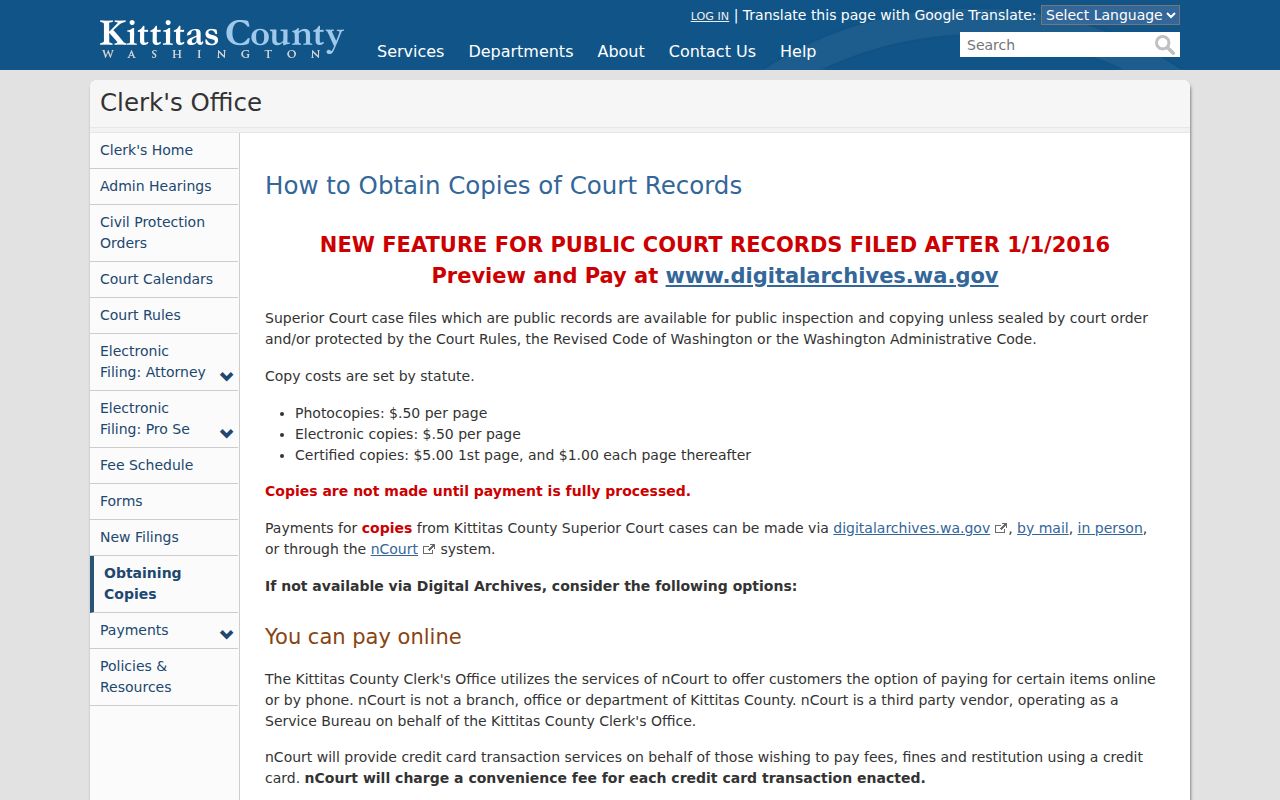
These routes matter more than they first appear. An index hit, an electronic copy, and a certified decree are three different products, and knowing which one you need saves a wasted trip.
What Cases Fill the Civil Docket
Kittitas Superior Court takes the big disputes: general civil matters and anything touching real property. The Clerk also indexes domestic dissolution, probate, guardianship, parentage, adoption, dependency, protection-order, and related files. Access rules differ across those categories. District Courts, in turn, handle limited civil matters, small claims, name changes, vehicle impounds, protection orders, and other proceedings within their jurisdiction.
| Case route | Typical custodian | Important limit |
|---|---|---|
| Superior civil dispute | Kittitas County Clerk | Use Civil search filters and request filed orders when needed. |
| Domestic or family | Kittitas County Clerk | GR 22 can restrict documents and identifiers. |
| Probate or guardianship | Kittitas County Clerk | These are distinct case types with different protected content. |
| District civil | Upper or Lower District clerk | The local court states a civil jurisdictional limit up to $100,000. |
| Small claims | Proper District Court clerk | Money-only claims and precinct venue rules apply. |
Small claims in Kittitas County carry dollar caps. The local pages set the limit at $10,000 for a natural person and $5,000 for any other claimant. Filing runs $50, and service costs extra. Venue usually follows the defendant's residence or the proper Upper or Lower precinct, and the clerk assigns the hearing, trial, or response date once the case is filed.
Kittitas Family Calendars Stay Narrower
The Clerk's calendar page carries a warning worth reading. Family-law matters do not display online the way other calendar material does. That is not secrecy for the whole case. A broad public calendar is the wrong tool for guessing whether a family matter is set. It also will not tell you when or why. General Rule 22 shields specified family-law, guardianship, protection-order, and therapeutic-court information from that kind of display.
Calendar limit: For a party seeking a setting in their own family matter, use the notice in the case and confirm with the Clerk rather than relying on the public weekly display.
General Rule 15 draws a second line. It runs between sealing and redaction. A sealed item has court-ordered access limits. A redacted public copy can still circulate once protected data is stripped out. Ask the Clerk what index information or redacted document can be released. Never read a missing online link as a statement about the case's status or merits.
Hearings on the Civil Docket
Kittitas County civil dockets carry motion calendars. They also list specially set hearings, trials, protection-order blocks, and post-judgment work. Read the labels with care. A "trial setting" may just pick or confirm a future trial date. It does not hold the trial itself. A continuance only moves an event, so the complaint stays alive. When the clerk enters the new setting or order, the docket should show it.
Superior schedules place civil protection-order motions on Wednesday and recurring civil work on Friday. District calendars run separately. An active live-stream link lets you watch a current public session under court rules. It is not a transcript, docket, or recording. For anything past, ask the court that held the hearing. Request the docket entry, order, or audio.
Kittitas Civil Filing Numbers
The 2025 annual Superior report covers Kittitas County. It counts 769 civil filings, along with 155 domestic, 200 probate or guardianship, and 21 adoption or parentage filings. The limited-jurisdiction report shows 380 civil and 662 small-claims filings in the Kittitas rows. These numbers count filed cases by state reporting category. They do not count parties, pending cases, trials finished, or docket events.
That filing mix explains why search filters and records routes split apart. Pick the wrong court or category. A broad civil query can miss a domestic, probate, guardianship, or small-claims file. Treat the counts as workload context only. The individual file needs its own court, category, year, and case number.
Who Can See Civil Dockets
Washington court records follow General Rule 31 for access. General Rule 15 covers sealing, redaction, and destruction. General Rule 22 adds controls for family-law, guardianship, protection-order, and therapeutic-court files. A public civil index does not open every document or identifier. Juvenile and dependency matters carry further statutory limits.
Name the case and document. That is the first step for an ordinary Superior civil copy. Then use Digital Archives if eligible or contact Karen Bowen, Kittitas County Clerk. Suite 210 in the Ellensburg courthouse takes walk-in requests. Mail works too, along with the Clerk's published electronic and payment channels. Ordinary paper and electronic copies run $0.50 per page. Certified copies run $5 for the first page plus $1 for each added page. Confirm charges before you order.
Lower and Upper District clerks keep their own limited-jurisdiction files. Lower lists paper copies at $0.50 per page and electronic copies at $0.25 per page. Upper lists the same base amounts, though its displayed electronic minimum is worth confirming first. Need the full filed paper rather than a case index? The separate Kittitas County court case records route explains copy and certification channels.
Kittitas Certified Decree Requests
A decree listed by title in a docket gives you a name. It does not give the paper itself. The index tells you the entry exists. To get a certified Superior copy, contact the Clerk. Bring the case number, the exact document name or entry date, your preferred format, and how you want it delivered. Staff can tell you the page count and the current certification cost before you pay.
- Use the docket or filing list to identify the decree and its filed date.
- Ask whether an electronic ordinary copy will serve the intended court-record purpose.
- If certification is required, request it expressly and confirm the page total.
- For mail delivery, include the instructed payment and stamped addressed envelope.
- Keep the clerk-issued certification with the copy rather than substituting a portal printout.
The Clerk takes requests by mail and at the counter. Payment goes through nCourt, a payment service that adds a convenience fee. Electronic copies can arrive by email. Paper or certified copies can be mailed once payment clears. Staff cannot tell you what legal effect a decree has. Name the record you want rather than asking the clerk to interpret it.