
Kittitas County Criminal Docket Searches
Check the charging paper, the notice, or an older docket entry. That shows which court holds the case. The free Washington Courts Search Case Records service splits its searches into Superior and District/Municipal paths. Felonies belong to Kittitas County Superior Court. A misdemeanor, a gross misdemeanor, or any limited-jurisdiction matter calls for the exact District or municipal court. Not every county case lands in Superior Court. Guessing here is the fastest way to miss the file.
A case number is the cleanest key for a docket search. Names trip people up. The state service warns its data may not prove identity, completeness, or current status. Keep the punctuation and leading zeroes intact. In Odyssey cases, party names appear as last name, first name, middle name. A broad search can hit the result cap. Narrow it with county, filing date, case category, status, or judicial officer.
- Identify the court level and the precise court name shown on the case paper.
- Search the state service by case number first, or use a carefully narrowed party-name search.
- For Superior Court, compare the result with Odyssey's Smart Search or Hearing Search.
- For a limited-jurisdiction filing near May 2026, also check the Tyler Court Records Search.
- Ask the clerk for the specific public document or a certified copy when the index is not enough.
Kittitas Criminal Cases in Odyssey
The Odyssey Portal is how Kittitas Superior Court case information reaches the public among participating counties. Anonymous users can search cases. The official FAQ is clear, though, that anonymous access does not include case documents. Restricted cases stay hidden. Smart Search takes a case number or a party name. Advanced Filtering Options trim the results by Kittitas location, date, criminal category, case type, status, or judicial officer.
For tracking a public Register of Actions, the portal works well. It does not replace a clerk-produced judgment or order. The portal guide asks for enough characters to make a search useful. It permits an asterisk as a wildcard for partial names or numbers. An event can show up in the system. The filed paper may not appear on screen. When a docket entry matters as proof, find the document name in the index. Then request it from Karen Bowen, Kittitas County Clerk.
The official Odyssey screen presents Smart Search, Hearing Search, and judgment-search options:
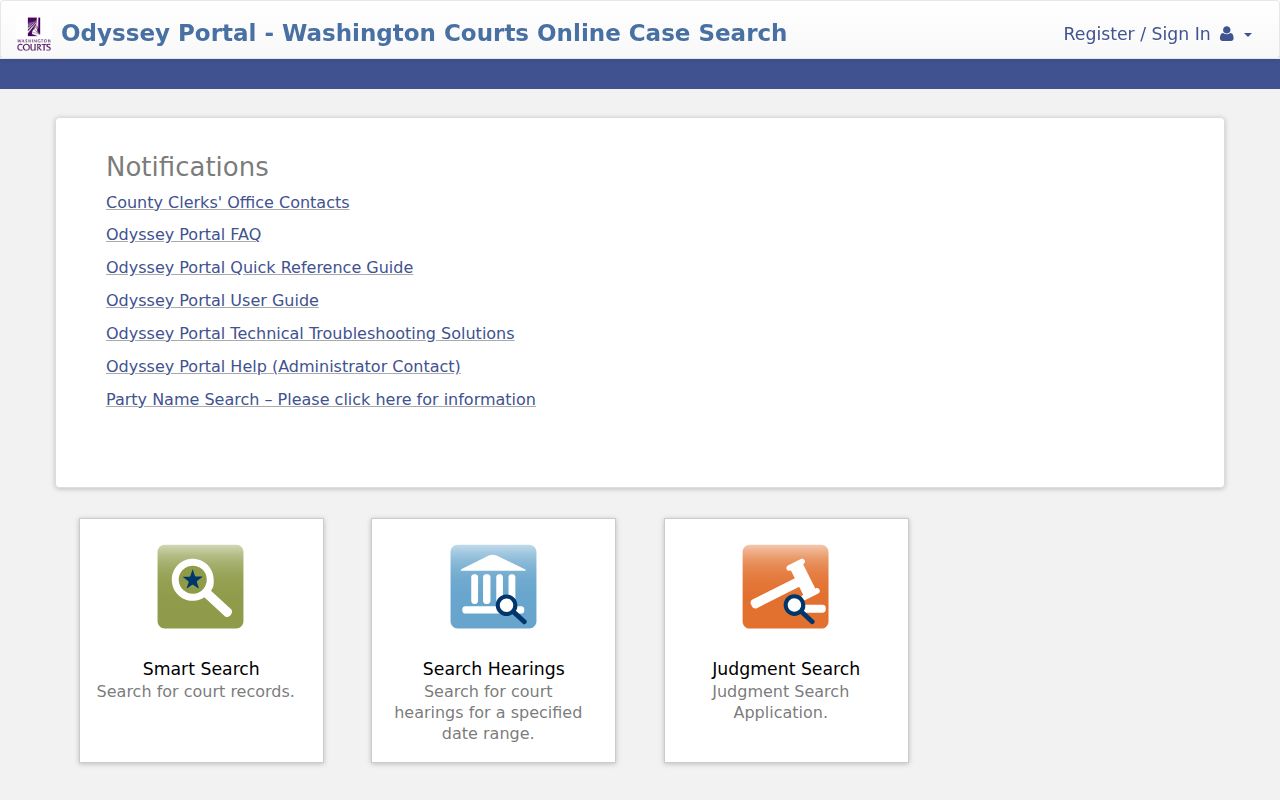
Those separate choices matter. A hearing lookup and a full case-activity lookup can answer different questions about the same criminal matter, so pick the one that fits yours.
Criminal Dockets: What They Show
A Kittitas County criminal docket usually splits into a case header plus events, settings, documents, and the result. Filings run in order, which means a later continuance, an amended charge, or a disposition can change what an earlier entry meant. Read through to the newest event before drawing conclusions from the first charge. One more caution: the case index is not a statewide criminal-history record, and the County Clerk states plainly that her office does not distribute criminal-history information.
| Case number | The court identifier, shown in the official format, such as court-issued number; retain letters, punctuation, and zeroes. |
|---|---|
| Case header | Court, case type, caption, filing date, and public party information. |
| Charges | The filed charge or count, subject to amendment, dismissal, or later disposition. |
| Events | Arraignments, pleas, motions, continuances, trials, orders, and warrants where public. |
| Settings | Date, time, department or courtroom, judicial officer, and hearing type when published. |
| Disposition | The recorded outcome event; read the judgment or order for the controlling detail. |
Kittitas Criminal Calendar Tracks
Kittitas Superior Court keeps a recurring schedule that separates in-custody and out-of-custody criminal work. The published schedule assigns Department 1 mainly to criminal matters. It runs distinct blocks for each calendar along with criminal motions. That split matters. Two cases sharing one broad hearing label can land in different sessions. It proves nothing about current confinement. A stale calendar should never be used to guess status.
The Superior Court schedule also notes that special settings go through Court Administration. Remember the difference in purpose. A calendar looks forward and can shift. A docket records what the clerk has entered in the case. For an urgent setting, compare the current Clerk calendar, Odyssey Hearing Search, and the notice in the case. Then confirm with the court.
Criminal Case Stages on the Docket
A criminal docket often opens with the charging filing. It then works through arraignment, pretrial activity, plea or trial, disposition, and sentencing. The path bends, though. Motions get continued. Charges get amended, and trials get reset. Washington's official code references cover families for arraignment, bail, continuance, disposition, deferred prosecution, motion, notice, order, plea, trial, waiver, and warrant or failure to appear.
Docket flow: Charge Filed › Arraignment › Pretrial Settings › Plea or Trial › Disposition › Sentencing
Some labels need translating. "Set" means scheduled, not completed. "Continued" means moved or postponed, not dismissed. "Disposition" points to an outcome event, yet without the event detail or order it cannot tell the full result. A judgment and sentence carries more weight than any short calendar label. And if an appeal follows, remember that the trial-court record and the Washington Court of Appeals, Division III record may carry different case numbers.
Kittitas Warrant Entries Need Confirmation
Treat any warrant or failure-to-appear entry as a lead, not a verdict. The statewide docket search updates on a schedule. It warns that results may not be complete or current. Plenty can happen after an old entry posts. A recall can change the picture. So can a quash, an appearance, a bond posting, or a new court order. So skip the cached page. Call a number you look up yourself, never one an unsolicited caller hands you.
For an Upper District matter, the official Upper District warrant page spells out show-cause scheduling, surrender, and bond procedures. Upper District Court publishes a current phone number for questions. Superior Court questions go to the Clerk or the right court office. Kittitas County also posts a warning worth heeding. Courts and law enforcement there never call demanding payment over a missed jury date or a warrant. Hang up. Dial the number printed on an official county court page.
For a Superior Court matter, contact the Clerk or the proper court office instead.
If an old warrant appears: Record the court and case number, avoid guessing at current status, and ask that court what the latest public order shows.
Kittitas County Criminal Docket Courts
Felony prosecutions in Kittitas County belong to Superior Court, the general-jurisdiction court. The Kittitas County Clerk files and indexes those records. You will find the office at 205 W 5th Avenue, Suite 210, in Ellensburg. Counter hours run Monday through Friday. Mornings run 8:30 a.m. to noon, and afternoons from 1 to 4:30 p.m. Bring a request that names the case number. It should also list the document or date range, the format, and how you want delivery.
Misdemeanors, gross misdemeanors, and infractions are split between the two District Courts. Lower District sits at the Ellensburg courthouse. Its number is 509-962-7511. Upper District sits at 700 E 1st Street in Cle Elum, reachable at 509-674-5533. Cle Elum and Roslyn municipal courts are listed at the Upper location. Ellensburg's City Attorney files its misdemeanor and gross-misdemeanor cases in Lower District Court. Kittitas municipal matters run through the Lower system too.
Kittitas Behavioral Health Docket Events
Kittitas County Behavioral Health Court is a partnership, not a building. Both District Courts, county prosecutors, participating cities, defense counsel, probation, and service providers take part. The official description covers referral, screening, and eligibility. The program runs at least 12 months. There is no separate public search database behind it.
That means a District Court docket may show referral, review, compliance, or program events. Read those entries within the limits of the public record. A program label does not tell you a diagnosis. It does not reveal a treatment detail or an outcome. General Rule 22 can restrict therapeutic-court information, and the clerk decides what gets released. The county program description lays out the program's public framework.
Access Rules for Criminal Dockets
Washington starts from openness. General Rule 31 presumes public access to court records, though other rules, statutes, and court orders can limit it. Sealing, redaction, and destruction fall under General Rule 15, which requires court findings before access is restricted. Juvenile records follow separate rules in RCW 13.50.050. Keep one gap in mind. A public index may be narrower than the underlying file, and protected identifiers can be pulled even when the rest of a docket stays open.
Key access rules:
General Rule 31 defines court records and governs public inspection and copying.
General Rule 15 governs sealing, redaction, and destruction through a court process.
RCW 13.50.050 sets distinct access limits for juvenile records.
No document link on an online result? Go to the County Clerk for a Superior record. For a limited-jurisdiction record, use the right District Court clerk. Superior copies can be requested through eligible Digital Archives records, by mail, in person, or through the Clerk's payment route once the cost is confirmed. A certified copy runs $5 for the first page and $1 for each later page under the current fee schedule. Check the charges before you pay.
Kittitas Criminal Filing Scale
The 2025 Superior annual report lists 280 criminal filings in Kittitas County. The limited-jurisdiction report adds detail across the county rows. It shows 71 felony complaints. DUI or physical-control filings number 1,248, with 82 other misdemeanors. These are filings in reporting categories. They are not counts of unique people, convictions, open cases, or docket events.
That volume explains the split system. Criminal information is divided among the statewide search, Odyssey, court calendars, and clerk copy channels because no one channel carries it all. One case can generate many docket entries. A single filing can stay active across years. Use the annual report for workload context only. For any individual case, go back to its latest docket activity and the order or judgment held by the proper clerk.